Skip to content

A free book by Carlos Murguía

The Scrolling Economy

A Practitioner’s Framework for Designing in the Age of Infinite Content

Work gets approved in a quiet room and judged in a moving feed. This book shows how to design for the feed.

Get the free book

12 chapters · 3 parts · Free PDF

The book

The book

What is The Scrolling Economy?

What is The Scrolling Economy?

The Scrolling Economy is a free book by creative director Carlos Murguía about designing for the feed. It treats attention as the currency, creative as the product and the feed as the marketplace, and it gives designers, creative directors and marketing leaders a framework for making work people notice in a second or two.

In a review, work gets a big screen and a room that’s paying attention on purpose. In the feed, it gets a second or two on a phone. Most briefs, reviews and metrics are still built for the room.

The Scrolling Economy is a free book by creative director Carlos Murguía about designing for the feed. It treats attention as the currency, creative as the product and the feed as the marketplace, and it gives designers, creative directors and marketing leaders a framework for making work people notice in a second or two.

In a review, work gets a big screen and a room that’s paying attention on purpose. In the feed, it gets a second or two on a phone. Most briefs, reviews and metrics are still built for the room.

What you’ll learn

What you’ll learn

Five ideas from the book

Five ideas from the book

“The presentation room is not the feed.”

“The presentation room is not the feed.”

In the review, work gets the whole room’s attention. In the feed, it gets a second or two. Design for where it will be seen.

Chapters 1 and 12

“The presentation room is not the feed.”

In the review, work gets the whole room’s attention. In the feed, it gets a second or two. Design for where it will be seen.

Chapters 1 and 12

“Design for the millisecond. Earn the second.”

“Design for the millisecond. Earn the second.”

Brand signals don’t register at the same speed. Color comes first, then silhouette, framing, ritual and texture.

Chapter 5

“Design for the millisecond. Earn the second.”

Brand signals don’t register at the same speed. Color comes first, then silhouette, framing, ritual and texture.

Chapter 5

“Signal is the currency you spend to earn the right to deliver a message.”

“Signal is the currency you spend to earn the right to deliver a message.”

Color, shape and contrast reach people before a single word does. Lead with them, and the message gets its turn.

Chapter 6

“Signal is the currency you spend to earn the right to deliver a message.”

Color, shape and contrast reach people before a single word does. Lead with them, and the message gets its turn.

Chapter 6

“Design the system. Earn the hero.”

“Design the system. Earn the hero.”

A consistent system of small pieces builds more recognition than one brilliant campaign that runs once.

Chapter 7

“Design the system. Earn the hero.”

A consistent system of small pieces builds more recognition than one brilliant campaign that runs once.

Chapter 7

“The scroll isn’t the enemy. It’s the brief.”

“The scroll isn’t the enemy. It’s the brief.”

The feed sets the constraints. Read them early, and the work gets sharper.

The closing line

“The scroll isn’t the enemy. It’s the brief.”

The feed sets the constraints. Read them early, and the work gets sharper.

The closing line

Carlos Murguía, The Scrolling Economy

Carlos Murguía, The Scrolling Economy

Contents

Contents

12 chapters in three parts

12 chapters in three parts

Part I · The Context

1

The Scrolling Economy

The scroll is the medium now, and most creative work still assumes a captive audience.

2

The Attention Collapse

What two decades of attention research say about how people really use screens.

3

The Economics of the Feed

Attention as currency, creative as product, and the four laws that run the feed.

Part II · The Framework

4

The Micro-Moment

The second or two a piece of work gets on screen, and what it can do in that window.

5

The Speed of Recognition

Color, silhouette, framing, ritual and texture, ranked by how fast they register.

6

Signal Before Message

Why the brief should start with what the eye catches first.

7

Systems Over Singles

Why a consistent system outperforms one big hero asset.

8

Design as Translation

Turning strategy into signals people feel before they read them.

Part III · The Practice

9

The Signal Brief

Five questions to add to the front of any creative brief.

10

Measuring What Matters

An impression isn’t attention. The three attention metrics worth tracking.

11

Building Teams for the Scroll

How teams change when they build systems instead of launches.

12

The Creative Standard

Five changes to creative reviews, so the room judges work the way the feed will.
A look inside

A look inside

From the pages

From the pages

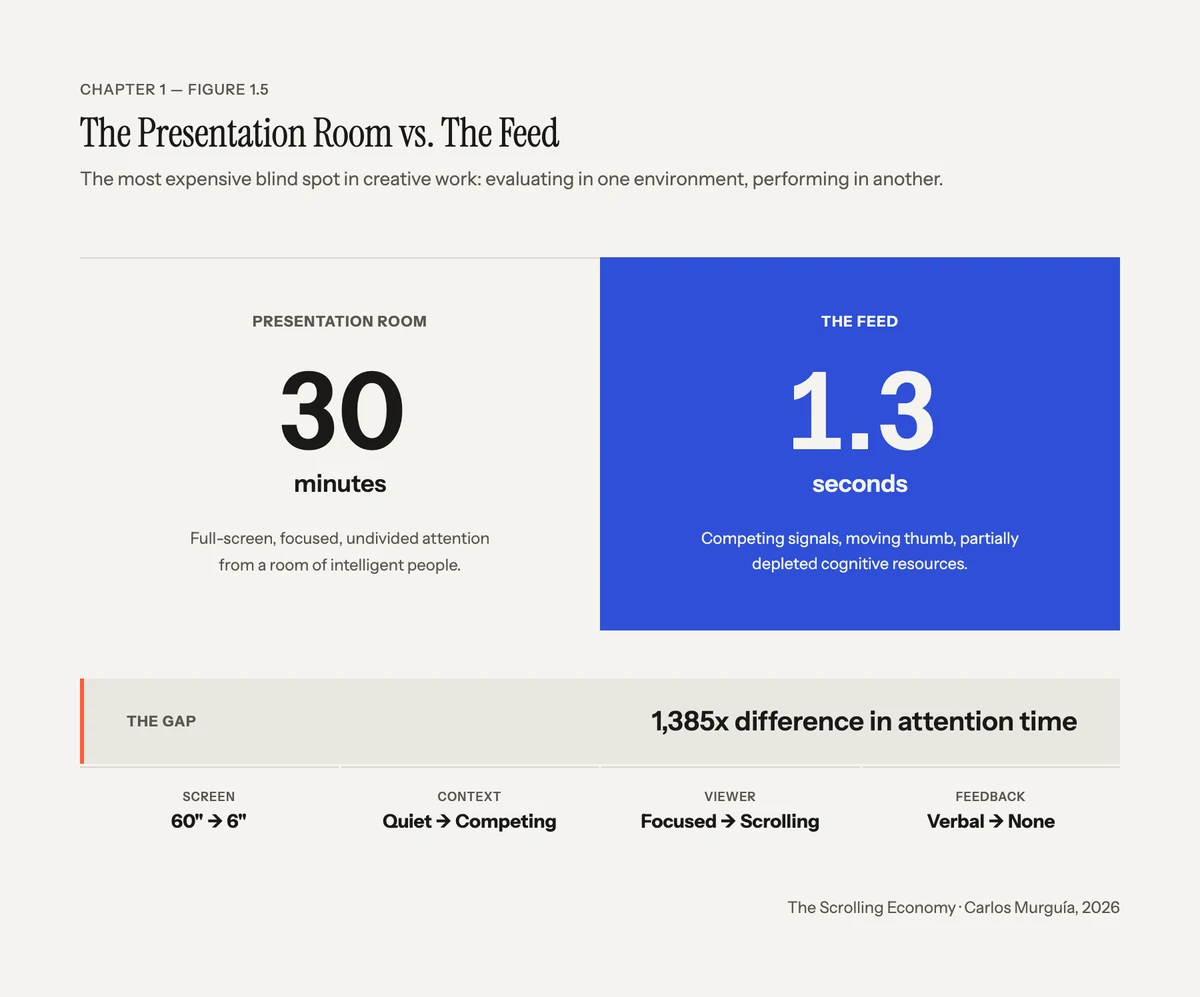
Diagram comparing the presentation room and the feed: 30 minutes of focused attention on a 60-inch screen versus 1.3 seconds on a 6-inch phone.

Chapter 1 · The presentation room vs. the feed

Diagram comparing the presentation room and the feed: 30 minutes of focused attention on a 60-inch screen versus 1.3 seconds on a 6-inch phone.

Chapter 1 · The presentation room vs. the feed

Chart of average attention on a single screen, falling from 150 seconds in 2004 to 75 in 2012 and 47 in 2023, from Gloria Mark's research.

Chapter 2 · How attention on a screen shrank

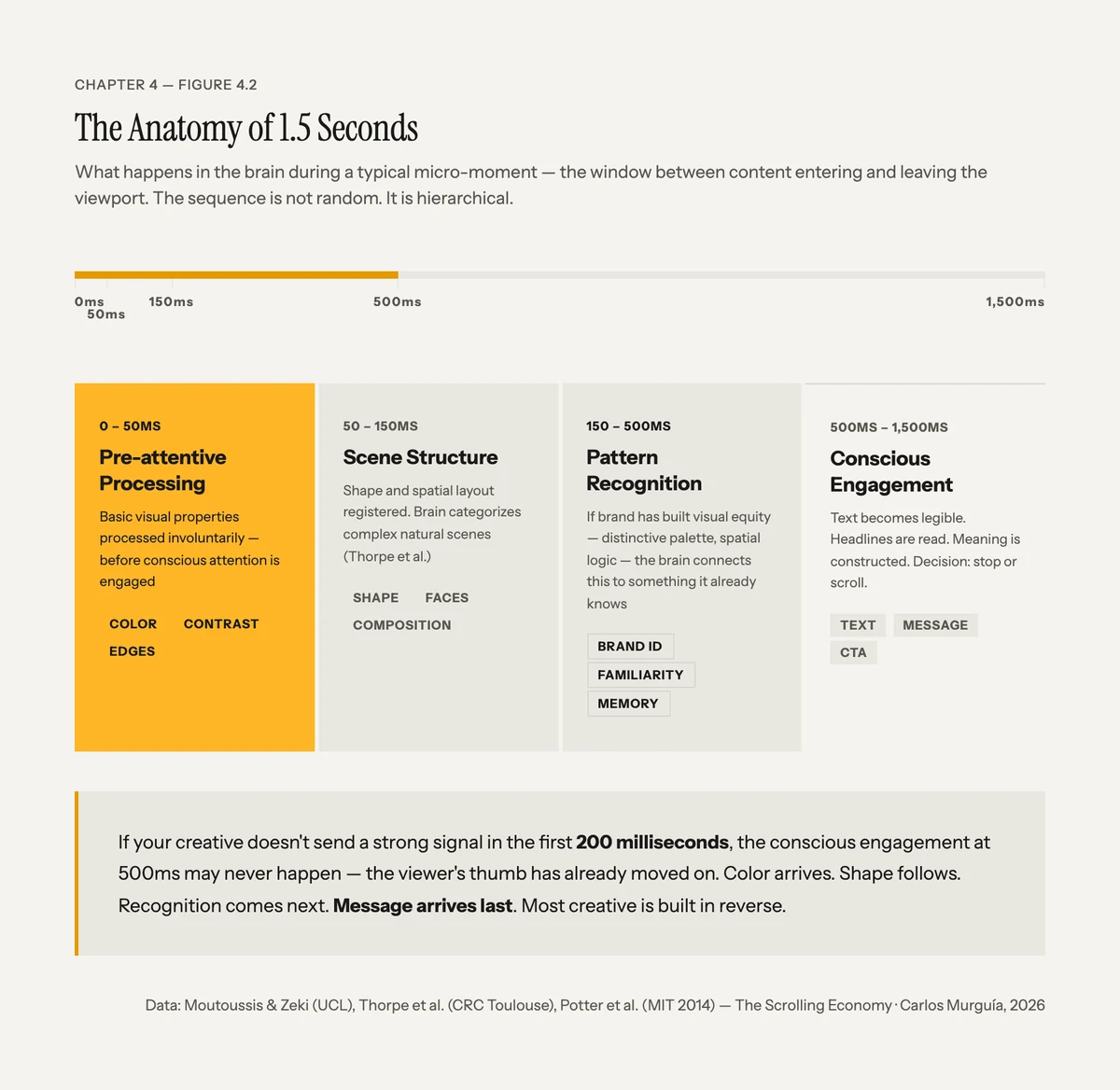
Timeline of the first 1.5 seconds of seeing a design: color and contrast by 50 ms, shape and layout by 150 ms, recognition by 500 ms, then reading and meaning.

Chapter 4 · The first 1.5 seconds

Timeline of the first 1.5 seconds of seeing a design: color and contrast by 50 ms, shape and layout by 150 ms, recognition by 500 ms, then reading and meaning.

Chapter 4 · The first 1.5 seconds

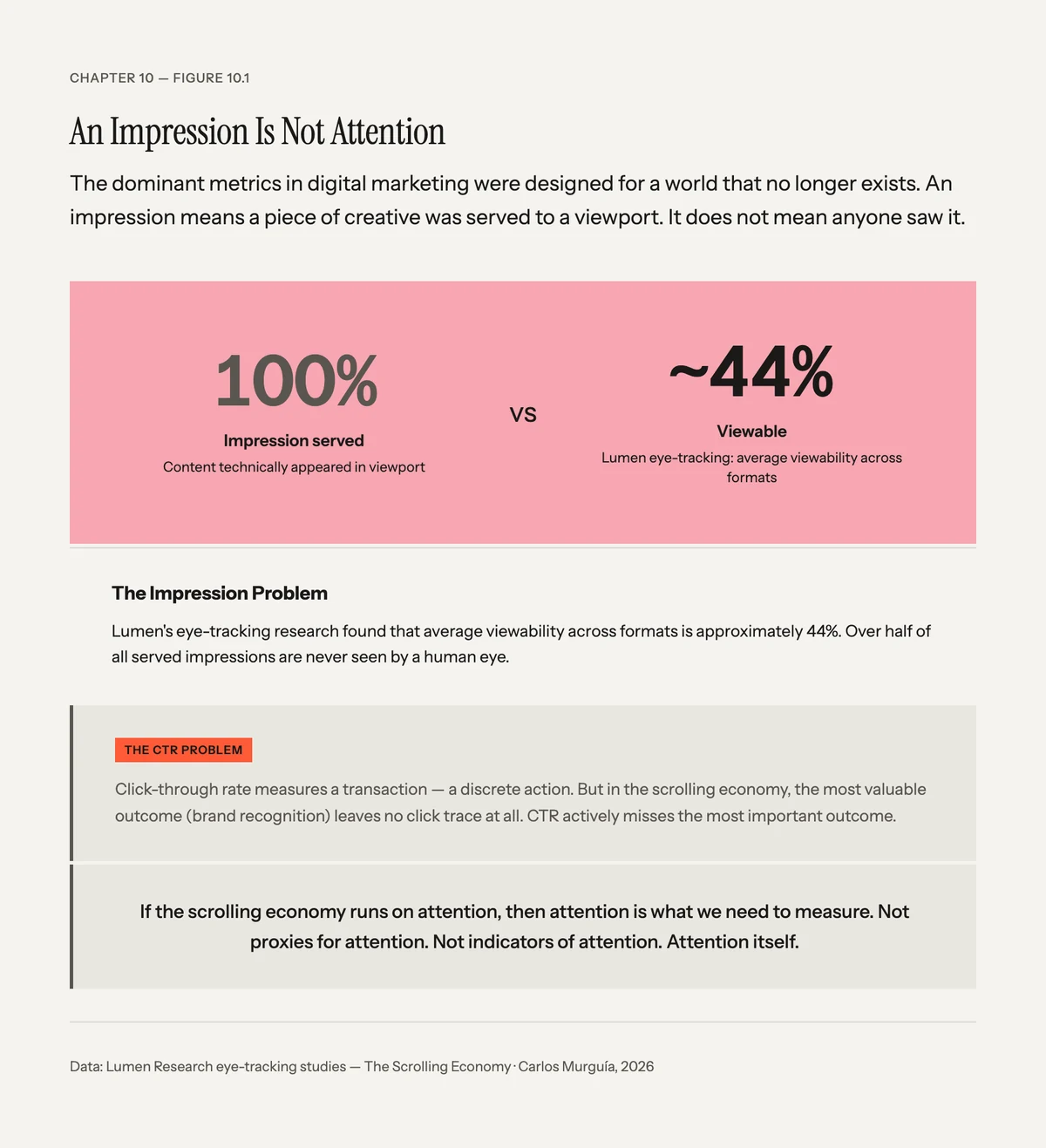
Impressions served vs. impressions seen, based on Lumen eye-tracking research.

Chapter 10 · An impression is not attention

Carlos Murguía, creative director

About the author

Carlos Murguía

Carlos Murguía is a creative director who makes brands and campaigns for USDA, the Smithsonian, the World Bank, Adobe and DC Jazz Festival. He grew up with Spanish at home and English at school, and he still thinks of design as translation. He wrote this book for everyone whose work has to hold up on a phone.

Writing or talking about the book? Get in touch

Carlos Murguía, creative director

About the author

Carlos Murguía

Carlos Murguía is a creative director who makes brands and campaigns for USDA, the Smithsonian, the World Bank, Adobe and DC Jazz Festival. He grew up with Spanish at home and English at school, and he still thinks of design as translation. He wrote this book for everyone whose work has to hold up on a phone.

Writing or talking about the book? Get in touch

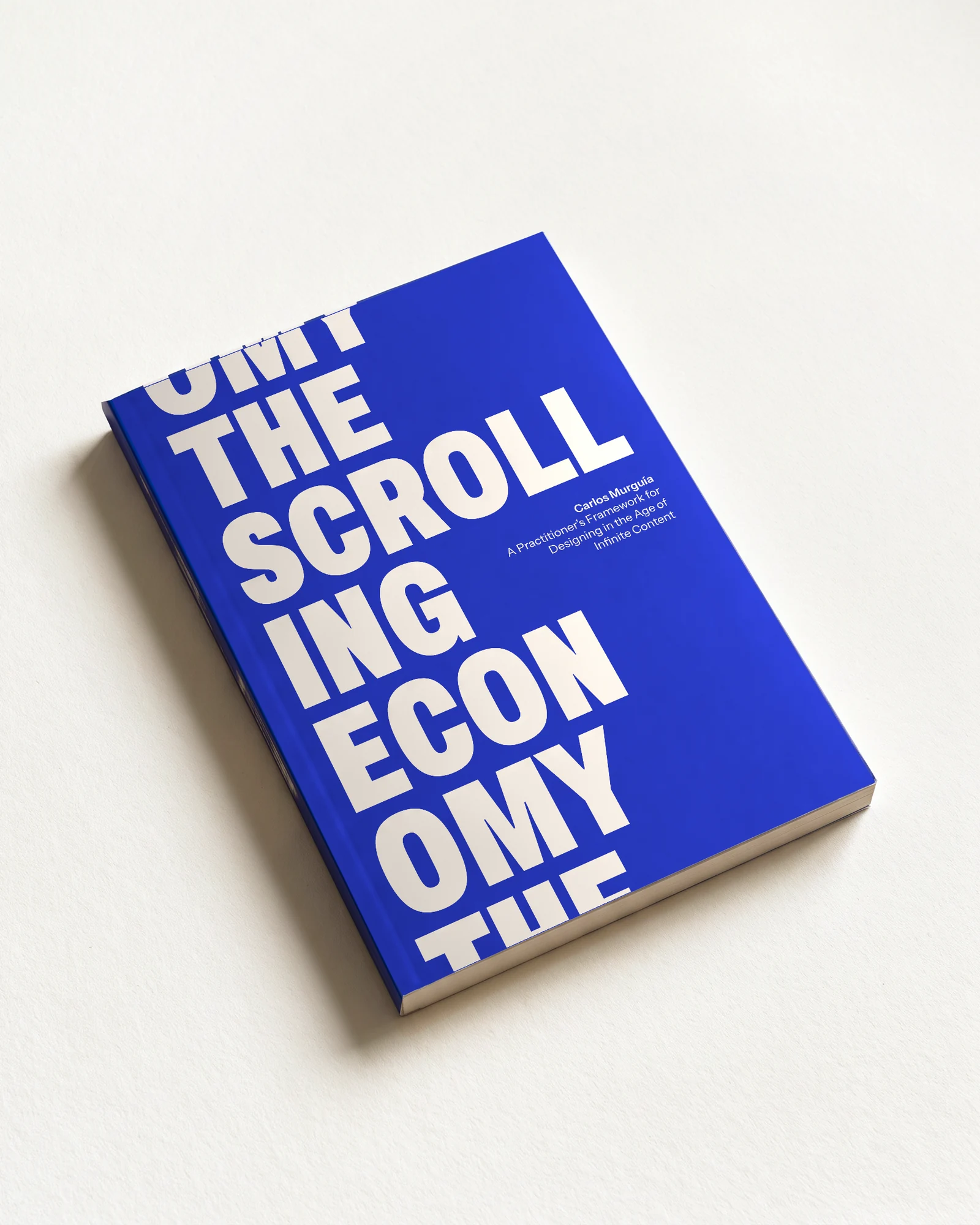
The Scrolling Economy by Carlos Murguía, a cobalt paperback lying on paper

Free download

Get the free PDF

Enter your email and the download starts on the next page.

Free download

Get the free PDF

Enter your email and the download starts on the next page.

I keep your email, your choice on updates and the date, so I know who’s reading. I never share or sell your email, and updates only go to people who check the box. Want it deleted? Send me a note and I’ll remove it. Privacy policy

I keep your email, your choice on updates and the date, so I know who’s reading. I never share or sell your email, and updates only go to people who check the box. Want it deleted? Send me a note and I’ll remove it. Privacy policy

Questions

Questions

Is the book really free?

Yes. The whole book, all 12 chapters, is a free PDF. All I ask for is your email.

Will I get marketing emails?

Only if you check the updates box. It starts unchecked.

Who is it for?

Designers, creative directors, brand strategists and marketing leaders who make work that has to earn attention in a feed.